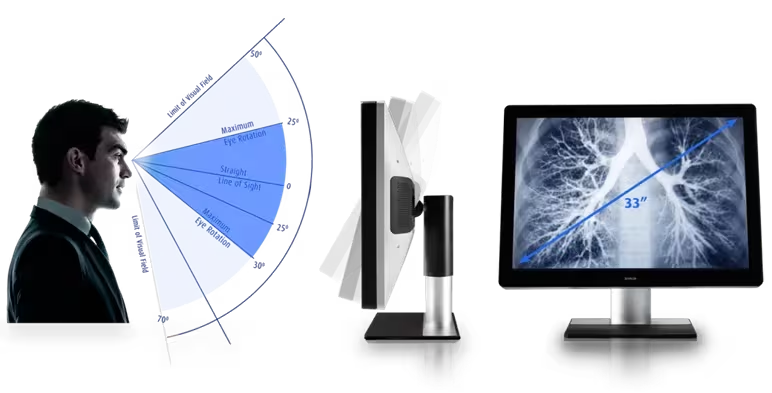
At a glance, most displays look the same.
Put a high-end consumer monitor next to a medical display and you might struggle to tell them apart. The image looks sharp, the brightness is good, and everything appears clear enough.
But in healthcare, “clear enough” isn’t the standard.
Clinicians aren’t just looking at images, they’re interpreting them. And that means every detail, every shade, and every variation in contrast has to be accurate, consistent, and reliable over time.
That’s where the difference really begins.
A consumer display is designed for everyday use, streaming, browsing, general productivity. It’s built to look good in the moment, often prioritising vibrant colours and visual appeal. But it isn’t designed to maintain that performance in a controlled, measurable way, and it isn’t calibrated for clinical accuracy.
Medical displays are.
They’re engineered specifically for environments where image quality directly impacts decision-making. One of the key reasons for this is adherence to the DICOM standard, which ensures that grayscale images, like X-rays or CT scans are displayed with the correct luminance and contrast. That consistency is critical. Subtle differences in tone can reveal important findings, and if those differences aren’t rendered properly, they can easily be missed.
It’s not just about calibration at the start, either. Over time, consumer displays naturally drift. Brightness drops, contrast shifts, and uniformity across the screen can degrade, often so gradually that it goes unnoticed. In a clinical setting, that kind of variability introduces risk.
Medical displays are designed to avoid that. They maintain stable brightness and uniformity throughout their lifespan, often using built-in sensors and automated quality assurance tools to continuously monitor and adjust performance. The goal is simple: what you see today should be just as reliable tomorrow.
And then there’s the detail.
Resolution is only part of the story. Medical-grade displays are optimised to reduce noise and enhance contrast in ways that make fine details easier to detect. In fields like radiology, that can make a meaningful difference. It’s not about making images look better, it’s about making them more useful.
All of this contributes to something less tangible, but just as important: confidence.
When clinicians trust what they’re seeing, they can make decisions more quickly and with greater certainty. There’s less need for second-guessing, fewer repeat scans, and a smoother workflow overall. It’s a quieter benefit, but one that has a real impact on both efficiency and patient care.
Of course, consumer displays are often seen as the more cost-effective option. And upfront, they usually are. But over time, the picture changes. Shorter lifespans, lack of calibration, and the potential for inconsistent image quality can all add up, not just in terms of cost, but in risk and operational inefficiency.
Medical displays are built with that long-term view in mind.
That’s why solutions from Barco focus not just on image quality, but on maintaining it consistently, reliably, and in line with clinical standards.
Because in healthcare, the question isn’t whether an image looks good.
It’s whether it can be trusted.
And that’s a very different standard altogether.









 Back to All News